Enterprise AI Workspace
How AI could connect information, people and workflows across a globally distributed workforce.
27 interviews
PMs, engineers and designers in 3 countries
3 pillars
Culture, information, time management
2 pitches
Presented to internal audiences
Context
Designing for a global workforce.
Teams spread across 150+ locations, time zones and work models were losing alignment. Information was scattered and collaboration slowed down.
As part of an 8-person Product Design Academy cohort, we explored how AI could help. My focus was turning our strategy into interface concepts and high-fidelity prototypes.
How might AI connect the tools people already use, instead of becoming one more system?
Research
27 interviews, three countries.
We interviewed product managers, engineers and designers in Brazil, the United States and Ireland, across roles, seniority and departments.

Findings
Three systemic challenges.
Alignment & communication
Too much unstandardised communication. Essential information got lost in the noise.
Platforms & tools
Disconnected tools, manual rework and fatigue with yet another system.
Organisation & culture
No shared remote-work practices, causing friction in day-to-day alignment.
User needs
Structure, connection, autonomy.
We grouped participants into three behavioural archetypes, used as patterns rather than rigid personas.
The Caregiver & The Ruler
Need for structure: clearer documentation and better coordination.
The Everyman
Need for connection: easier ways to find people, teams and communities.
The Sage
Need for autonomy: reliable information and less repetitive admin work.
Strategy
Three pillars.
The opportunity wasn't another AI tool. It was making information, people and workflows more connected.
Culture
How might we strengthen collaboration through shared remote-work practices?
Information
How might we make people, projects and research easier to find?
Time management
How might AI reduce bureaucratic, repetitive work?
Product
A personalised AI workspace.
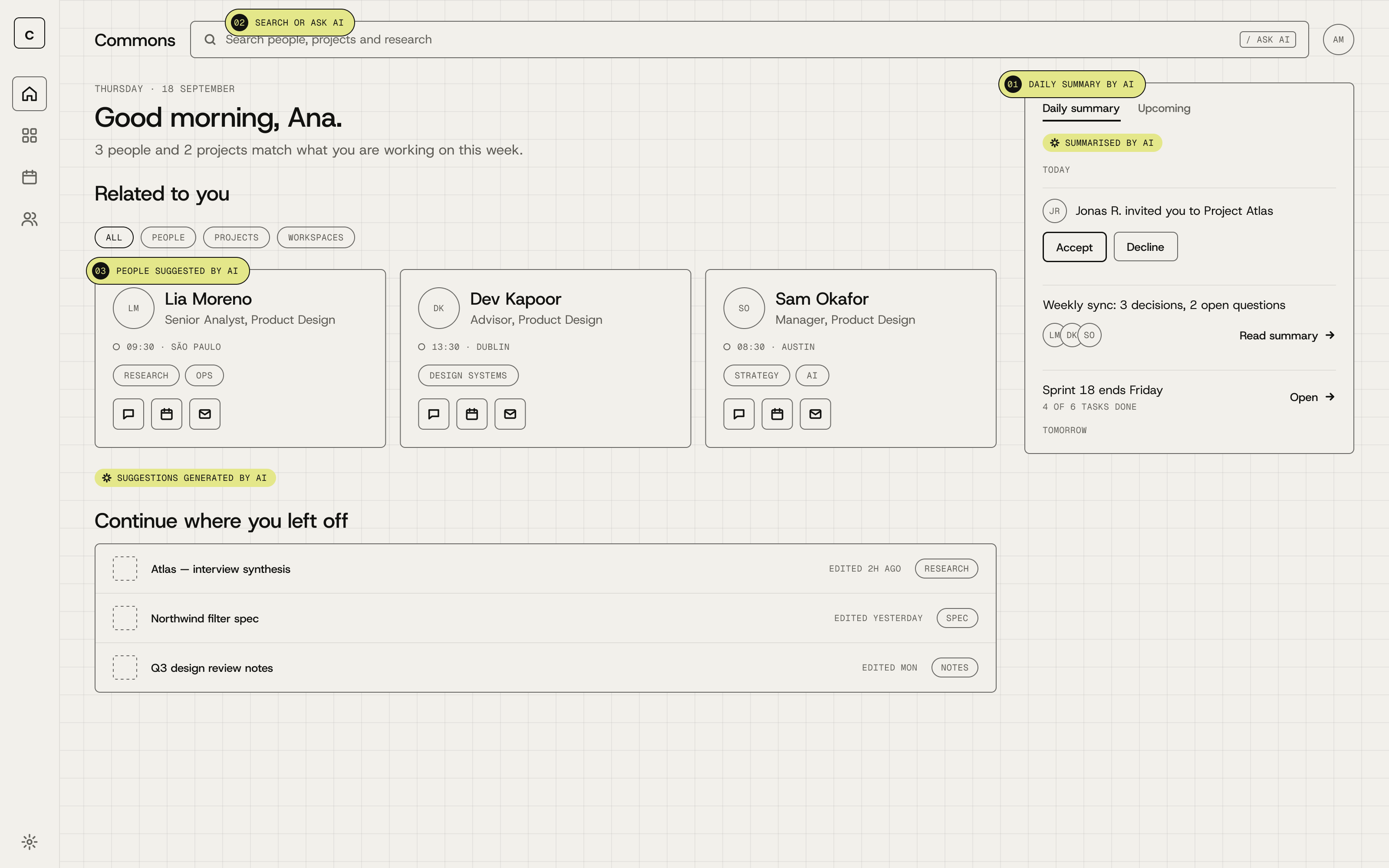
An AI-powered dashboard as a single entry point to people, projects, research and updates, connecting existing tools instead of replacing them.
Centralised search
One place to find people, projects, research and internal resources.
Smart daily summary
AI curates what matters based on each person's role and priorities.
Modular cards
Users tailor the dashboard to their own workflow.
System alignment
Built on established enterprise patterns for consistency and accessibility.
Prototype
From concept to high-fidelity.
I translated the strategy into high-fidelity interface concepts and interactive prototypes, showing how search, personalisation and the daily summary would work in practice.
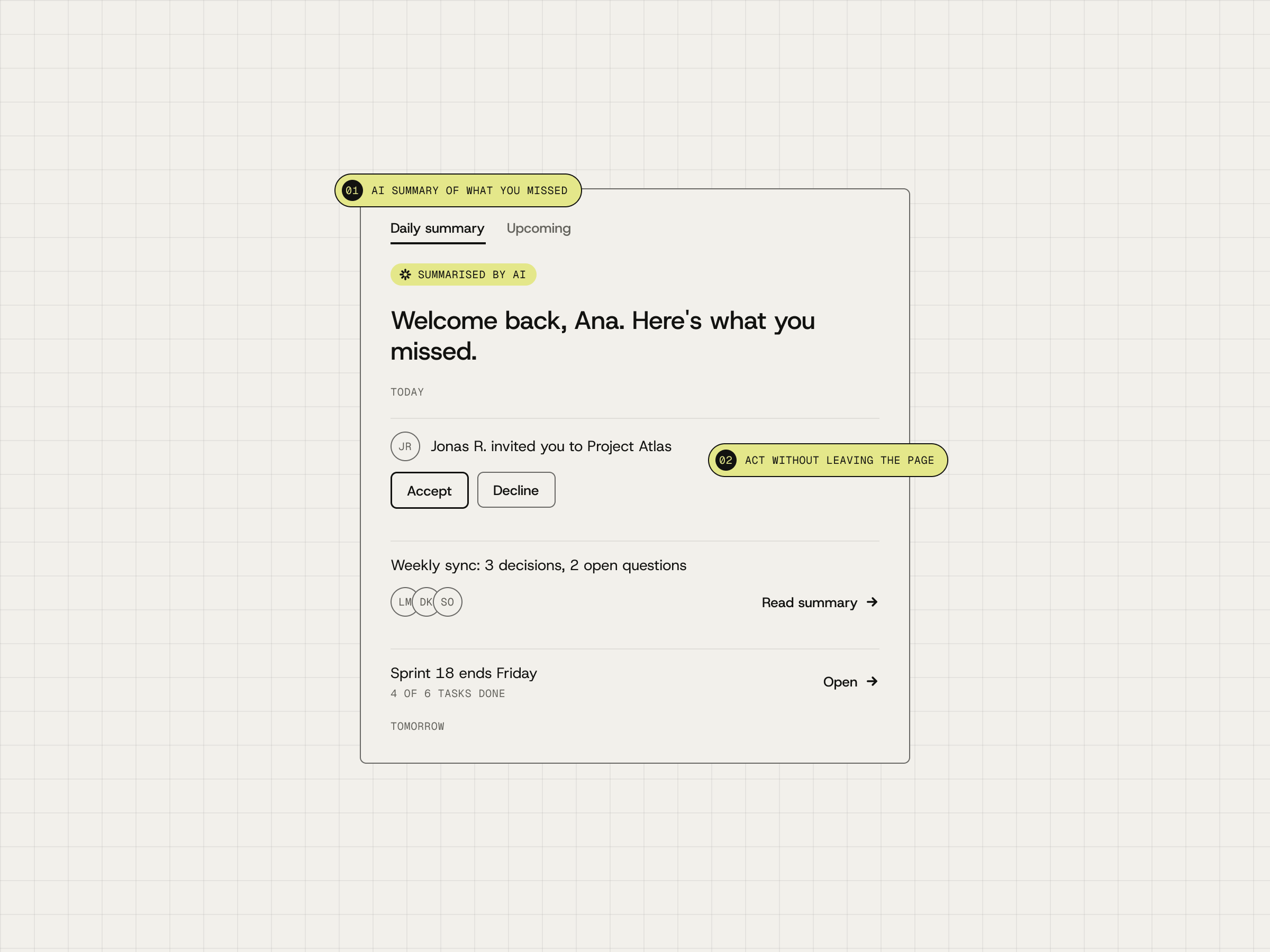
Smart daily summary

Centralised search
Outcome
A tangible product direction.
A strategic pitch and a high-fidelity prototype for an AI workspace.
I presented the concept to internal audiences twice.
After the Academy, I joined the company's product design team as an intern.
Looking back: in an enterprise, you design for the systems, behaviours and organisation around a feature, not only the feature itself.